
 Spain
 Sweden
 Dutch
 Japan
 Poland
 Germany
 Italy
 France
 Portugal
 Norway

Disraeli Gears - Misheard and Misnamed
Disraeli Gears: How a Misheard Bicycle and a Handful of Days in New York Produced a Proper Classic
Picture three musicians, not long out of their teens or just into them, rattling around London in an Austin Westminster in the spring of 1967. One of them is talking about the superior virtues of a proper racing bicycle — the sort fitted with derailleur gears that let you change ratios without grinding to a halt and looking like a man wrestling a lawnmower. Their roadie, Mick Turner, who is doing the driving, leans into the conversation with what he imagines is a helpful contribution. “Has it got them Disraeli gears?” he asks. The car fills with the particular sound of people who have spent far too much time together suddenly discovering something ridiculous. Benjamin Disraeli, the Victorian prime minister who never once expressed an opinion on chainrings, has been accidentally recruited into the world of cycling hardware. The three decide, with the unshakeable logic of men who already think the idea is funny, that this has to be the name of their next record. Thus Disraeli Gears acquired a title that has nothing to do with statesmanship and everything to do with a perfectly ordinary bit of mishearing that stuck because it made them laugh.
Cream were still, in certain circles, a relatively new proposition. They had been assembled in 1966 from pieces of other bands: Eric Clapton arriving from the Yardbirds and John Mayall’s Bluesbreakers, Jack Bruce and Ginger Baker from the Graham Bond Organisation and various other outfits that had already demonstrated their ability to fall out with one another. By the time they reached their second album they had been together for less than a year. Their debut, Fresh Cream, had shown them as a loud, capable blues-based trio with a useful facility for volume and a certain amount of instrumental showing-off. It had not, however, suggested that they were about to produce something that would sit so comfortably between the blues they already knew and the psychedelic weather that was settling over everything else in 1967. Jimi Hendrix had turned up and made electric guitar sound like a different instrument. The idea of simply recreating Chicago blues at greater volume was beginning to feel limited. Cream, for all their reputation as a power trio, were ready to try something else.
The recording itself was conducted with a speed that would now be considered almost reckless. Most of the work was done at Atlantic Studios in New York between the 11th and 15th of May 1967. Their American visas were due to run out, which supplied a useful deadline even if nobody was claiming it as an artistic strategy. Producer Felix Pappalardi, who would later form Mountain, and the engineer Tom Dowd kept the sessions moving. The band were not especially fluent in studio technique at that point. They tended to record a backing track in one or two takes, add whatever overdubs seemed necessary, and move on. Visitors came and went — Booker T. Jones, Otis Redding, Janis Joplin and others — which gave the rooms a slightly festive atmosphere. Ahmet Ertegun, the head of Atlantic, was less immediately convinced by some of the material. He is reported to have described one of the new songs as psychedelic hogwash until Booker T observed that it had the shape of a proper hit. Ertegun adjusted his view, which was just as well.
What emerged was a record that still carried blues DNA without being content to stay inside it. “Strange Brew,” the opening track, began as a cover of Albert King’s “Lawdy Mama.” Pappalardi took the backing track away, rewrote the lyrics with his wife Gail Collins, and returned it as something closer to a bright, slightly McCartney-shaped pop song for Clapton to sing. The guitar solo still nods towards the original blues source, but the overall effect is different. “Outside Woman Blues,” Clapton’s arrangement of a Blind Joe Reynolds number, sits more squarely in the older tradition and features the creamy, sustained guitar sound that was becoming one of his trademarks. Elsewhere the album moves further from straightforward blues. Short, contained songs replace the long improvisations that dominated the live shows. Effects pedals appear. Lyrics written with the poet Pete Brown introduce a more elliptical, occasionally surreal quality. The whole thing feels like a band that has decided to keep the weight of their playing while trying out different shapes for the songs themselves.
“Sunshine of Your Love” is the clearest example of the new approach. Bruce and Brown had been working through the night without much success. Bruce picked up a double bass, looked out of the window as the light began to change, and started playing the descending riff that still defines the track. Brown glanced outside, noted that it was getting near dawn, and wrote the line down. Clapton later supplied the turnaround section with its “I’ve been waiting so long” melody. The finished song, with Bruce and Clapton trading vocals over Baker’s distinctive drum pattern, became the album’s most widely recognised piece and the single that did the most to establish Cream in America. It is also one of the few tracks from the period that still turns up on radio without sounding like a period piece. The riff is heavy enough to have influenced a generation of later bands, yet the song itself never loses its shape or its sense of forward motion.
The rest of the album contains its share of oddities, most of which only make complete sense in the context of the year they were recorded. “SWLABR” is an acronym that expands to something along the lines of “She Was Like A Bearded Rainbow” or “She Walks Like A Bearded Rainbow.” The story attached to the title involves flowers ordered for a girlfriend; when they arrived, Brown was struck by the way the long stems swayed and compared the movement to the way certain women walked. The flowers turned out to be irises of a variety known as bearded rainbow. The song itself is angular and propulsive, less concerned with conventional romance than with a slightly combative view of relationships. “Tales of Brave Ulysses” pairs Clapton’s newly discovered wah-wah pedal with lyrics by Martin Sharp, the Australian artist who also designed the cover. The words draw on a trip to Ibiza and on the older story of the sirens. “Dance the Night Away” uses twelve-string guitars in a manner that nods towards the Byrds and was written, according to Bruce, as a celebration of the simple pleasure of dancing after he had stopped taking drugs. “We’re Going Wrong” is quieter and more inward, with Bruce employing an unusually high head voice that sits above the band rather than inside it.
Ginger Baker’s contribution, “Blue Condition,” is the track that has attracted the most mixed comment over the years. Baker sang the lead vocal himself. Asked about it later, he was characteristically direct: he could not stand the sound of his own singing and regarded the result as thoroughly awful. Bruce took a more tolerant view, comparing it to the traditional Ringo track on a Beatles album — not the song most listeners put on first, but part of the internal balance of the group. The album ends with “Mother’s Lament,” an old music-hall number performed in broad Cockney accents, with Bruce on piano and carefully keeping his Glasgow accent away from the microphone. It was recorded, by all accounts, as a bit of end-of-session nonsense and then included because someone decided it belonged. In its way it is a very British gesture: a reminder that the three of them were not trying to pass themselves off as something they were not, even while they were making a record in New York under visa pressure.
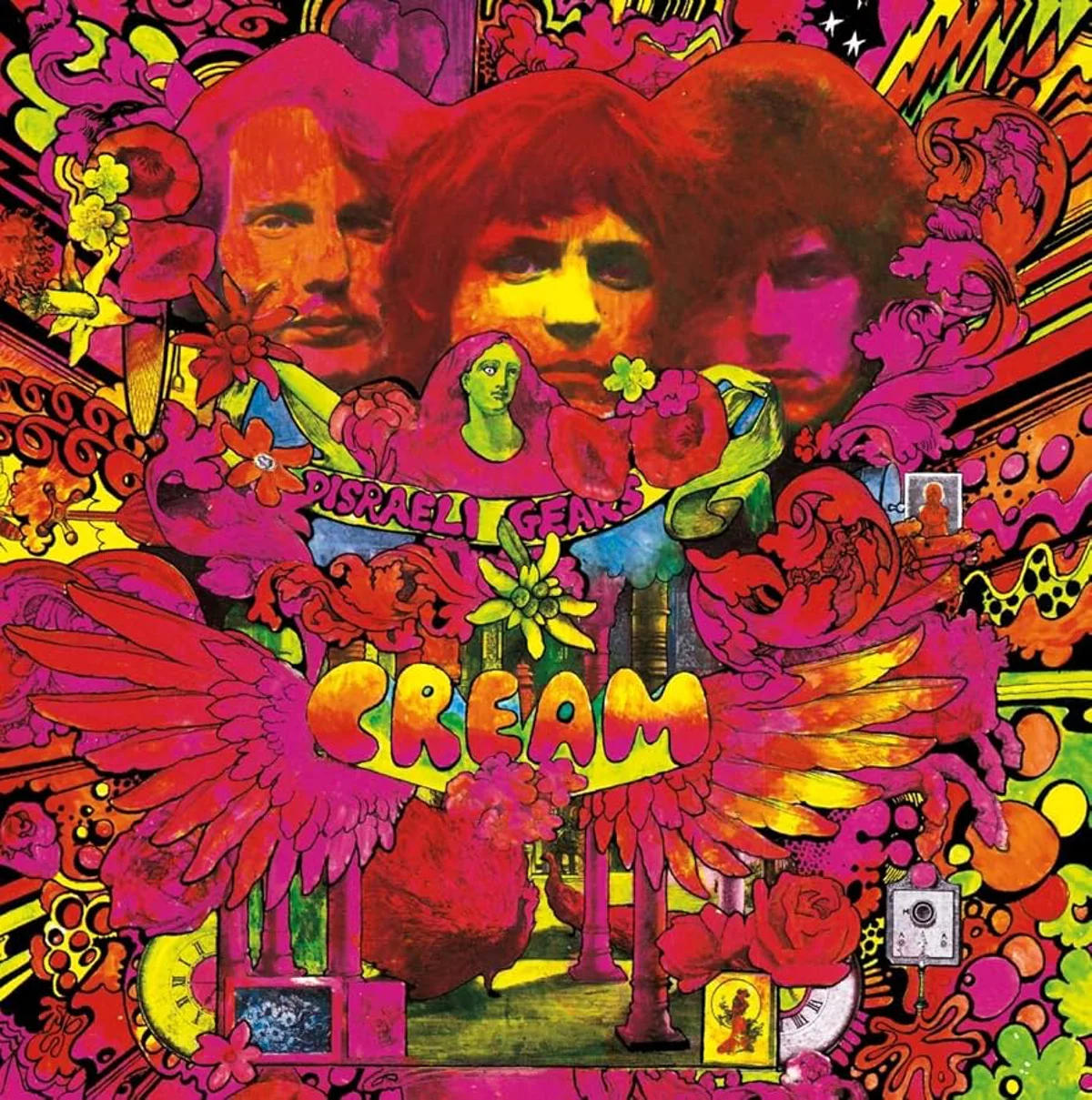
The cover, designed by Martin Sharp, is as much a part of the album’s identity as the title or the songs. Sharp and Clapton were living in the same Chelsea building. After a chance meeting, Clapton asked him to produce the sleeve. Sharp cut up publicity photographs, added collage elements drawn from books and other sources, and painted over the assembled image in fluorescent inks. He wanted the result to suggest the warm, electric quality of the music. One of his reference points was a set of Cambodian sculptures he had seen on the way to England: carved faces from which trees had grown over the years, so that three faces seemed to have music emerging from them. The finished sleeve is a dense arrangement of faces, flowers, wings, peacocks and swirling patterns that still looks like a concentrated version of 1967. Photographs by Bob Whitaker appear on the package as well.
Released in Britain on 2 November 1967 on Reaction Records, and shortly afterwards in the United States on Atco, the album sold well on both sides of the Atlantic. It reached number five in the UK charts and number four in America, and topped the lists in several other countries. “Strange Brew,” released as a single in June with “Tales of Brave Ulysses” on the reverse, made a modest showing in Britain. “Sunshine of Your Love,” issued in December, did the larger commercial work in the US. The record helped turn Cream from a well-regarded British trio into an international act. It is generally regarded as their strongest studio album: tighter than the debut, less sprawling than the double set that followed, and better focused than either.
What continues to recommend it is the sense that three strong, not always harmonious personalities managed to produce something that still sounds like a band rather than a collection of soloists. The playing is forceful — Clapton’s sustained guitar lines, Bruce’s melodic bass, Baker’s inventive drumming — but it is placed in the service of songs that mostly know when to stop. The humour is still audible: in the accidental title, in the decision to include Baker’s reluctant vocal, in the Cockney singalong that closes the side. Cream were never especially interested in sounding like a pure blues revival act. They wanted to take the language and the weight of the blues and apply them to whatever they were actually living through at the time. In the spring and summer of 1967 that meant fluorescent colours, a short American visa, a roadie’s malapropism, and a set of songs that managed to be both heavy and distinctly odd. Disraeli Gears remains the clearest evidence that the approach worked, and that a record knocked together in a few days can still sound considered nearly sixty years later.




Thank you for posting your blog comment. It will be reviewed and set live soon. If you provided your email then you will be notified of replies to this comment.