
 Spain
 Sweden
 Dutch
 Japan
 Poland
 Germany
 Italy
 France
 Portugal
 Norway

How Motörhead made Ace of Spades (Mostly by accident)
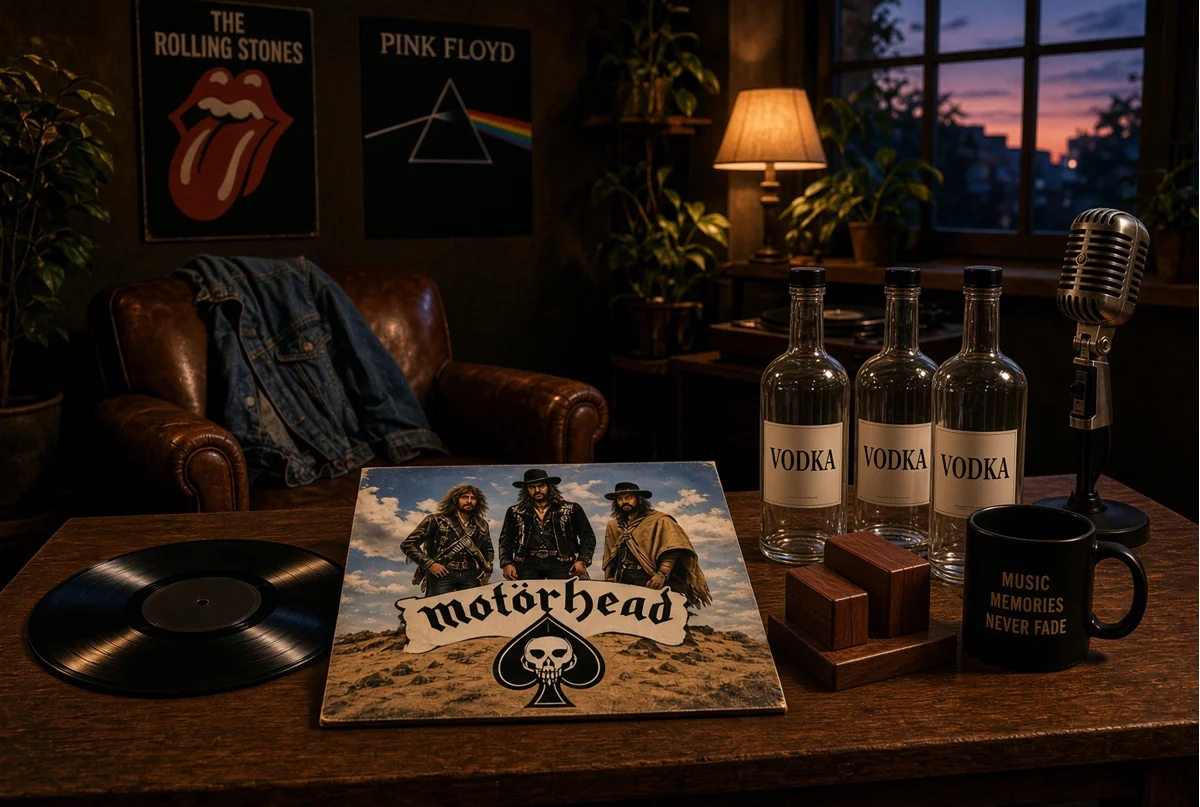
By the middle of 1980 Motörhead had already established that they could generate a volume and a velocity few other bands cared to match. Overkill and Bomber had appeared in quick succession the year before, and the live Golden Years EP had nudged them, almost by accident, into the lower reaches of the charts. A fourth album was required. No one involved appears to have approached the task as an exercise in career strategy. The intention was simply to make another Motörhead record that sounded like the three of them playing at full stretch, only this time with the details a little more audible than before.
Work began with a short period of rehearsal at Rockfield Studios in Wales. Fast Eddie Clarke later described the fortnight with characteristic directness: the band took the vodka and the rest of the usual supplies, Lemmy arrived with company and was therefore only intermittently available, and he and drummer Phil Taylor spent much of the remaining time fishing, idling, and eventually knocking riffs into shape. One of those riffs became the foundation of the title track. They recorded a rough instrumental version before returning to London. It was already recognisable, yet the central guitar figure still needed sharpening and the breakdown that Lemmy would afterwards call the “tap-dancing section” had not yet been invented.
The proper recording sessions ran from early August to mid-September at Jackson’s Studios in Rickmansworth, a converted nineteenth-century barn whose high ceiling and solid walls proved surprisingly suitable for a band that preferred to play loudly. The producer was Vic Maile. He had engineered for Hawkwind in the early 1970s and had worked with a range of other artists who did not ordinarily share a bill with Motörhead. The band nicknamed him Turtle, partly because of his appearance and partly because he moved through the sessions with a calm that contrasted sharply with their own habits. Maile did not drink or smoke, and he was diabetic, which meant he required ordinary food at ordinary times. Clarke observed later that it was difficult to argue with a man who might become seriously unwell if handled too roughly. As a result, the band largely accepted his direction.
Maile’s contribution was not to restrain the band but to ensure that their established sound was captured with greater clarity. On previous albums the mix had been a more collective affair. Here he took responsibility for it himself. Clarke noted afterwards that you could finally hear everything that was happening. Lemmy said Maile encouraged him to sing rather than simply shout. Taylor felt he was pushed to play with greater solidity. None of these adjustments altered the essential character of the music. The band still arrived in the afternoon with bottles of vodka and white wine, still played at a volume that filled the room, and still left for the clubs once the evening’s work was finished. The difference was that someone in the control room was listening carefully and was not joining in the refreshments.
The title track demanded the most attention. Maile heard the riff the band had brought from Rockfield and suggested they examine it again. Clarke and Lemmy worked on the figure in the studio itself—one of the few occasions, Clarke recalled, when they actually wrote while the tapes were running. The more conspicuous intervention involved a cardboard box of percussion instruments that Maile kept for unexpected purposes. Among the maracas and other items were a set of wood blocks. He proposed that the band use them to accent the breakdown. According to Clarke, the three of them were unenthusiastic. They were either drunk or speeding, or both, and the prospect of standing in front of a microphone striking pieces of wood did not appeal. They agreed to attempt it on the explicit understanding that the result would not appear on the record. The first efforts were poorly coordinated. Once the parts locked together and reverb was added, however, the sharp rhythmic clatter sounded effective. They decided it could stay.
Lemmy wrote the lyrics in the back of a Transit van travelling at speed, or so he maintained. Clarke suggested, with the dry scepticism of long acquaintance, that they might equally have been composed in less glamorous surroundings. The words form a compressed sequence of gambling images—cards, dice, and the dead man’s hand of aces and eights that Wild Bill Hickok held when he was shot. Lemmy later admitted that he preferred slot machines to cards, but observed that it was difficult to construct a convincing lyric around spinning fruit. The finished song states its case in under three minutes and ends.
The remainder of the album was completed in the same concentrated period. “(We Are) the Road Crew” offered a direct acknowledgement of the people who moved the equipment and kept the shows functioning. Other tracks continued the band’s established concerns with velocity and subjects that required little elaboration. Girlschool contributed to one number, adding a second guitar and a contrasting vocal without disturbing the overall tone. The basic tracks were largely performed live, with overdubs added afterwards. Session tapes reveal a degree of headphone bleed on the vocals, which is the natural consequence of three musicians playing at high volume in the same space.
The sleeve photographs were taken at a sandpit in Hertfordshire. The sky that day was unhelpful, so a more convincingly Western blue was substituted later. The three members were costumed as different varieties of cowboy: Clarke somewhere near Clint Eastwood’s Man with No Name, Taylor closer to Marlon Brando, and Lemmy as a version of Bret Maverick. The image remains one of the more successful attempts by a British band to appear at home in a landscape free of motorway service stations.
The album appeared in late 1980. The single reached the Top 20. The band performed on Top of the Pops and Tiswas, and a few years later on The Young Ones. None of these appearances suggested that Motörhead had become a conventional chart act. They simply confirmed that a substantial number of people wanted to hear the song.
What continues to distinguish the record is how little the sessions resembled a calculated bid for wider success. The band rehearsed when the mood allowed, recorded at volume, negotiated briefly over the use of wood blocks, and produced at least one set of lyrics in the back of a van. Maile’s role was to insist on clarity and to introduce a small number of ideas the band would not have reached unaided. The outcome is a document of three musicians who preferred playing to almost any alternative occupation, captured with sufficient precision that each contribution remains distinct. The circumstances that produced it—a converted barn in Hertfordshire, a producer who required his Ryvita at six o’clock, and a band persuaded to strike pieces of wood together only because they had been told, calmly, that the experiment might be worthwhile—only make the durability of the result more striking.
You can buy the Ace of Spades LP here




Thank you for posting your blog comment. It will be reviewed and set live soon. If you provided your email then you will be notified of replies to this comment.